Facing a child support calculation can feel overwhelming, but understanding the process is the first step toward securing a fair and stable future for your children. In Texas, the process is built around a clear formula, but getting the details right is critical for your family's well-being. You just need to determine the paying parent's net monthly income and apply a set percentage based on the number of children involved.
While the formula itself is straightforward, navigating the specifics of what counts as income, what deductions are allowed, and when a judge can deviate from the guidelines requires confidence and clarity.
The Basic Calculation: A Step-by-Step Breakdown
The entire process of calculating child support is guided by the Texas Family Code to ensure consistency and fairness for families across the state. It all begins with identifying the paying parent's total gross income before any taxes or deductions are taken out. This isn't just a salary; it includes everything from wages and bonuses to self-employment earnings and rental income.
The goal is to establish a clear, predictable system that parents can rely on.
Here is the step-by-step procedure a Texas court follows:
- Add Up All Gross Income: You will combine every source of monthly earnings to get a complete picture of financial resources.
- Make the Right Deductions: From the gross income, you subtract federal income tax, Social Security, Medicare, union dues, and the cost of the child's health insurance.
- Find the "Net Resources": This final number is what the court uses to calculate the support amount.
- Apply the Guideline Percentage: The percentage is based on the number of children. It's 20% for one child, 25% for two, 30% for three, and so on.
Determining Net Resources
The key to an accurate calculation is knowing exactly what you can—and can't—deduct from gross income. The Texas Family Code is very specific about these deductions to keep the process uniform from one case to the next. You cannot subtract personal living expenses like your car payment or rent.
The most common allowable deductions include:
- Federal income tax (calculated for a single person claiming one exemption).
- Social Security and Medicare taxes (FICA).
- Union dues, if they are mandatory for your job.
- The amount you pay for the child's health insurance premium.
Factoring in Healthcare and Custody Time
Once you have the base support number, the child's health insurance premium is added back into the total obligation for the paying parent. While the percentage calculation doesn't change, the amount of time you spend with your child, known as "possession and access," can be a significant factor a judge considers when finalizing the support order.
For more details on who is eligible to request support in the first place, you can review our guide on who can file for Texas child support.
“Understanding net resources is the foundation for accurate support amounts.”
An Example from a Real-World Scenario
Let's walk through a practical example. Imagine a parent makes $6,000 a month in gross income. After subtracting $1,000 for taxes, FICA, and union dues, their net monthly resources come out to $5,000.
If this parent has two children, the base child support obligation would be $1,250 per month. That's 25% of their $5,000 net resources.
Now, let's say this same parent also pays $200 a month for the children's health insurance premium. The court would add that amount to the base support, making the final ordered amount $1,450. The system is designed this way to be predictable, which helps both you and the other parent plan your finances and focus on what truly matters—your children.
A piece of practical advice: gather your pay stubs, tax returns, and proof of insurance payments as early as you can. Having your financial documents ready from the start makes the entire process faster and far less stressful.
Standard Texas Child Support Percentages
Texas courts rely on a standard set of percentages outlined in the Texas Family Code to calculate child support. This table shows the guideline amounts based on the number of children before the court.
| Number of Children | Percentage of Net Resources |
|---|---|
| 1 | 20% |
| 2 | 25% |
| 3 | 30% |
| 4 | 35% |
| 5 | 40% |
| 6 or more | Not less than 40% |
These percentages create a clear and consistent starting point for judges. However, a judge can deviate from these guidelines if the specific circumstances of your case show it's in the child's best interest.
The Core Principles of Texas Child Support
Figuring out child support in Texas can feel like a confusing math problem, but before you start digging through pay stubs and tax returns, it’s helpful to understand the core ideas that shape every calculation in the state. Once you grasp why Texas does it this way, you'll feel much more confident in the process.
Unlike many other states, Texas uses what's known as a percentage-of-income model. This is a critical distinction. It means the law focuses almost entirely on the income of the parent paying support (the "obligor") to determine the final amount.
This is a different approach from the "Income Shares" model you see in most of the country, where both parents' incomes are combined to figure out a proportional amount. In fact, by 2016, a supermajority of U.S. jurisdictions had already shifted to the Income Shares method. If you're curious about the national context, you can read the full research about these child support models to see how Texas stands apart.
It All Comes Down to "Net Resources"
In Texas, the entire calculation hinges on one key term: net resources. This concept is defined right in the Texas Family Code, and it’s much broader than just your take-home pay. The idea is to get a complete and fair picture of all the money available to support a child.
So, what does that actually include? The law casts a wide net, looking at all sources of financial resources, such as:
- Wages and salary, which covers everything from commissions and overtime to tips and bonuses.
- Self-employment income, a frequent point of contention that requires meticulous documentation, especially for business owners.
- Rental income from any properties you own.
- Retirement benefits, pensions, and annuities.
- Social Security benefits (but not Supplemental Security Income, or SSI).
- Disability benefits and unemployment benefits.
- Gifts and prizes, especially if they represent a recurring source of funds.
Essentially, if it’s money coming into your bank account, the court will likely count it as part of your gross resources before making any deductions.
The court's goal is simple: to ensure the child's standard of living is preserved as much as possible after a divorce or separation. Defining "net resources" so broadly helps achieve that by capturing a parent's true ability to pay.
Why This Model Matters for You
Understanding that Texas focuses on the paying parent's income and uses such a broad definition of resources is the most important thing you can know from the start. It tells you exactly which financial documents matter most and where disagreements are likely to pop up—especially if you or the other parent are a business owner or have a variable income.
This foundation helps you anticipate what a judge will look for, whether you're trying to negotiate a settlement in mediation or presenting your case in a courtroom. Knowing these principles empowers you to gather the right information from day one, setting the stage for a fair and accurate child support order. It helps prevent surprises and allows you to advocate effectively for your family.
Getting Your Financials in Order
If there’s one step you can’t afford to get wrong in a child support case, it's getting your financials in order. Everything that follows—the calculations, the final order, everything—hinges on a complete and honest picture of your finances. This isn't just about your paycheck. Texas law is very clear and very broad about what the court needs to see.
To make a fair decision, the judge has to understand your complete financial reality. That means looking at every single dollar coming in the door, not just what you earn from your 9-to-5.
What “Gross Resources” Really Means
The starting point for any calculation is what the Texas Family Code calls your "gross resources." Think of it as your total income before a single tax or deduction is taken out. It’s a deliberately broad term designed to capture your true financial capacity.
This includes the obvious sources, like:
- Wages, salaries, commissions, and bonuses from your job.
- Income from your business if you're self-employed or a freelancer.
- Rent checks from any investment properties you own.
- Retirement pay, pensions, and Social Security benefits (though not SSI).
- Dividends, interest, and capital gains from investments.
But it also catches things you might not consider "income," like severance pay or annuities. The whole point is to establish a clear, comprehensive baseline. It's a process rooted in economic models that estimate the real cost of raising kids, which can easily be 24% to 45% of a family's income. You can see how these economic models work and how they shape the guidelines courts use today.
From Gross to Net: The Allowable Deductions
Once you’ve added up all your gross resources, the next step is to subtract a very specific list of deductions to find your "net resources." This is the number the court will actually use for the percentage calculation. And here’s where many people get tripped up: you cannot subtract your mortgage, car payment, or grocery bills.
The Texas Family Code only allows you to deduct these specific items:
- Federal income tax (calculated as if you were single with one exemption)
- Social Security (FICA) and Medicare taxes
- State income tax (if you work in a state that has one)
- Union dues, if they are a mandatory condition of your employment
- The amount you pay for the child's health insurance premium
A Word of Caution for Business Owners: If you’re self-employed, the court will look closely at your books. Trying to write off a personal car payment or a family cell phone plan as a business expense to lower your reported income is a huge red flag. Keep your personal and business expenses completely separate.
Nailing down these numbers correctly prevents costly mistakes and future court dates. It gives the judge a transparent, legally sound foundation to build a fair child support order—one that works for you, the other parent, and most importantly, your child. Getting these documents ready now is one of the smartest things you can do to make this whole process smoother.
Applying the Guideline Formula Step by Step
Once you’ve determined the net monthly resources, you're ready to apply the Texas guideline percentages. This is where the numbers start to form a clear picture of the base child support amount. The process isn't meant to be a mystery; it’s designed to be predictable and fair, ensuring your children get consistent support.
The formula itself, straight from the Texas Family Code, is direct. The percentage of your net resources you'll owe is tied to how many children are involved in your case. For one child, the guideline starts at 20%. It then climbs with each additional child:
- Two children: 25% of net monthly resources
- Three children: 30% of net monthly resources
- Four children: 35% of net monthly resources
- Five or more children: 40% of net monthly resources
This infographic provides a quick visual of how your total earnings are distilled down to the net income figure used for this exact calculation.
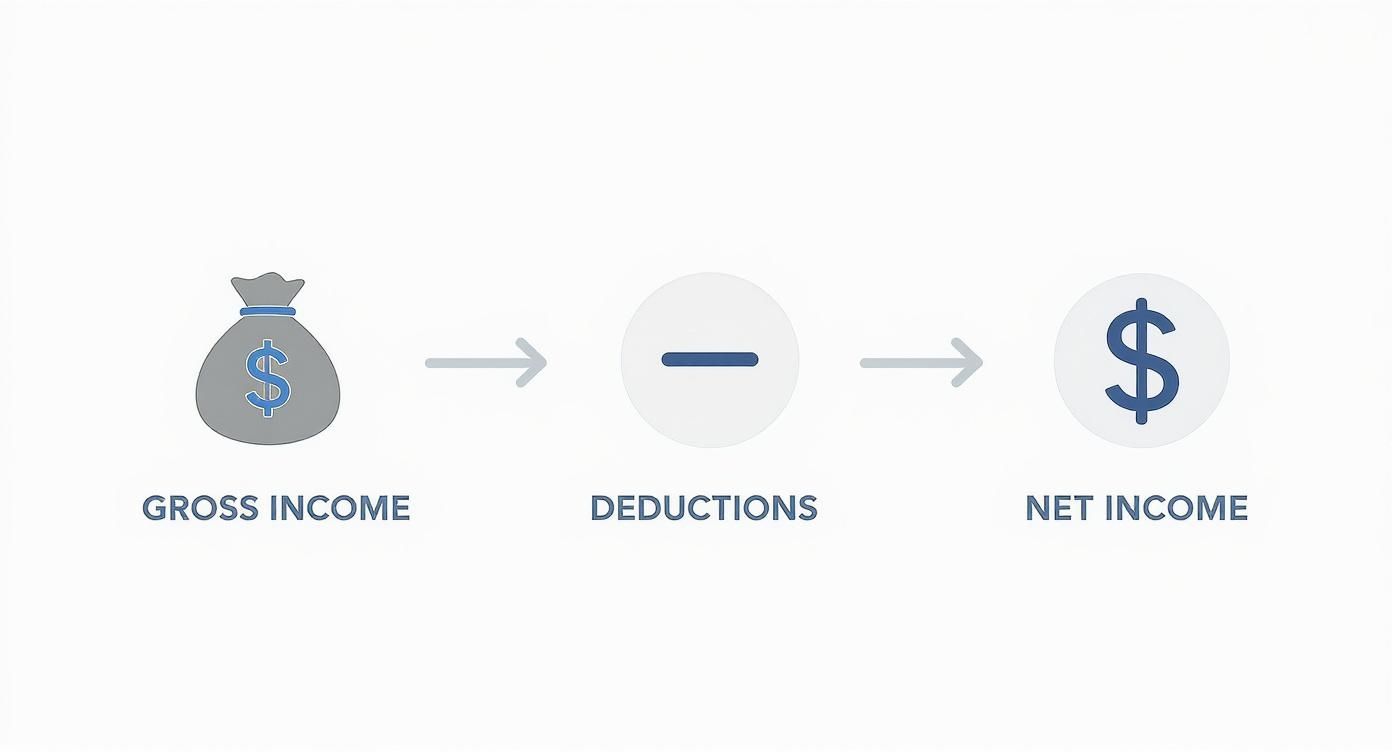
As you can see, the path is always the same: start with gross income, subtract only the legally allowed deductions, and arrive at the net income that drives the final support amount.
Factoring in Health Insurance Costs
But the calculation isn't quite finished. The final step is to account for the child's health and dental insurance premiums. This is a critical piece of the puzzle. Whichever parent is paying the bill for the child's insurance gets a credit for that cost in the final child support order.
Let's walk through a common real-world scenario. Imagine the non-custodial parent has $5,000 in net monthly resources and one child.
- Find the Base Support: At 20%, the initial support obligation is $1,000.
- Account for Insurance: That same parent also pays $300 a month for the child's health insurance premium.
- Determine the Final Order: The parent gets credit for that $300 they're already paying. The court will order them to pay the base support amount, but just as importantly, they must continue providing that insurance coverage. The final order makes sure this financial responsibility is fully recognized.
This two-step process—calculating the base percentage and then adjusting for insurance—is exactly how a Texas court ensures the final figure is equitable and properly covers the child's essential needs.
It's also crucial to understand how taxes impact this entire process from the very beginning. For a deeper dive, you can learn more about whether child support is calculated before or after taxes in Texas in our related guide. This practical breakdown cuts through the legal jargon, shows you exactly how a judge will arrive at the initial child support number, and gives you the clarity you need to move forward.
When a Judge Can Deviate From the Guidelines
While the Texas child support formula gives you a predictable starting point, you know your family’s situation better than any guideline ever could. Fortunately, the law agrees.
A Texas judge has the authority to order child support that is higher or lower than the standard percentage. For that to happen, the evidence must clearly show that a different amount is in the best interest of the child.
This flexibility is crucial because life isn’t one-size-fits-all. Sticking rigidly to the formula could be deeply unfair to your child or to one of you, especially in unique circumstances. If you believe your situation warrants a different approach, you absolutely have the right to present your case and ask the court to deviate from the standard calculation.
Common Reasons for Deviation
Judges don’t take this decision lightly. You can't just ask for a different amount; you must provide clear and convincing proof that a deviation is necessary and justified.
The Texas Family Code lists several factors a court can consider when deciding whether to adjust the standard support amount.
Some of the most common reasons a court might order a non-guideline amount include:
- Special Needs of the Child: If your child has extraordinary medical, educational, or psychological needs that require costs far beyond typical expenses, the court can increase the support order to help cover them.
- High Travel Costs: When parents live far from each other, the cost of travel for visitation can become a real burden. A judge might adjust the support amount to help the non-custodial parent afford to maintain a strong, consistent relationship with the child.
- Intentional Unemployment or Underemployment: If a parent deliberately quits a high-paying job or chooses to work less just to lower their child support obligation, a judge can calculate support based on that parent’s earning potential, not their current (and artificially low) income.
- Possession and Access: If the paying parent has the child for a significantly greater amount of time than a standard order provides (for example, a true 50/50 split), a judge may reduce the support amount to reflect the direct costs they're already covering.
This ability to tailor orders is a hallmark of the U.S. legal system. In many other parts of the world, particularly lower-income countries, child support is often handled through informal negotiations instead of set formulas, leading to inconsistent outcomes for children. If you're interested in a broader perspective, you can discover more insights about global child support policies and see why Texas's defined guidelines—and the ability to deviate from them—are so important.
While the reasons for deviation are varied, they all hinge on what is best for the child. The table below breaks down some common scenarios a court might consider when deciding whether to adjust the standard child support calculation.
Common Reasons for Deviating From Guidelines
| Reason for Deviation | What It Means | Real-World Example |
|---|---|---|
| Child's Special Needs | The child has costs that go far beyond what's considered typical, such as for medical care, therapy, or specialized education. | A child with severe autism requires expensive weekly therapy sessions and attends a special private school. The court may increase support to help cover these high costs. |
| High Cost of Access | The non-custodial parent has to spend a significant amount of money on travel just to see their child. | The custodial parent moves to another state. The court might lower the non-custodial parent's support obligation to offset the cost of plane tickets for visitation. |
| Intentional Underemployment | A parent purposely earns less than they are capable of to try and reduce their child support payment. | A skilled electrician quits his $80,000/year job to work part-time at a coffee shop. The judge can base child support on his proven earning potential of $80,000. |
| Disproportionate Direct Costs | The paying parent covers a much larger share of the child's direct expenses than usual, often due to an expanded possession schedule. | The parents have a 50/50 possession schedule, and the paying parent provides all the child's clothing, school supplies, and extracurricular activity fees. The court may reduce the support amount. |
Understanding these factors is the first step. The next is being able to prove them in court.
Pro Tip: Proving that a deviation is necessary requires solid evidence. This isn't about what you think is fair; it's about what you can document. Think medical bills, school tuition statements, travel receipts, or even expert testimony about a parent's true earning capacity. An attorney can be invaluable in helping you gather the right documentation to build a compelling argument.
Common Questions About Texas Child Support
Even with a clear formula, your life rarely fits neatly into a worksheet. Every family's situation is different, and you probably have questions about how the rules apply to your life.
Let's address some of the most common and complex "what ifs" we hear from Texas parents every day. Understanding these nuances is key to ensuring your child support order is fair, sustainable, and truly serves your child’s best interests.
What if My Income Changes Month to Month?
For anyone with a variable income—like salespeople, freelancers, or business owners—calculating a steady "net monthly resource" can feel impossible. When your income isn't consistent, a court won't just look at one good month or one bad one.
Instead, a judge will typically look at your earnings over a longer period, often the previous year or two, to figure out a fair monthly average. This is why your tax returns are so critical; they provide a realistic history of your earning capacity, smoothing out the peaks and valleys.
How Does a 50/50 Schedule Affect Child Support?
This is one of the biggest questions we get. While Texas law presumes the non-primary parent will pay support, a true 50/50 possession schedule can absolutely be grounds for deviating from the standard guidelines.
But here’s the key takeaway: a 50/50 split does not automatically eliminate child support. The court will still look at both of your incomes. If there's a significant gap in what each of you earns, the higher-earning parent may still be ordered to pay some support to ensure the child’s standard of living is consistent between both homes.
Can College Expenses Be Included?
In Texas, a standard child support order ends when the child turns 18 or graduates from high school, whichever happens later. A judge cannot force a parent to pay for college tuition or expenses if they don't agree to it.
However, you and the other parent can agree to include college support in your final divorce decree. If you both consent to this arrangement and it's written into your court order, it becomes a legally enforceable contract. As you weigh these financial details, it's also wise to consider the related tax implications of divorce, which can affect your long-term financial picture.
Next Steps After Calculating Texas Child Support
Calculating child support often feels like more than just a math problem—it’s about protecting your child's future while ensuring the outcome is fair for everyone involved. While the Texas guidelines provide a solid starting point, real life rarely fits into a neat little box.

Things can get complicated fast, especially with issues like proving a spouse's self-employment income, uncovering hidden assets, or making sure a child’s special medical or educational needs are covered. These situations can turn a simple calculation into a major legal challenge. The single most important thing you can do is get a firm handle on your rights and obligations under the Texas Family Code.
Key Takeaway
If you feel even a little bit unsure about any part of this process, or if you have a gut feeling that the standard formula just doesn't fit your family's situation, it’s time to talk to an experienced lawyer. It’s not about making things more complicated; it’s about getting it right.
An attorney can step in to:
- Ensure Accuracy: We can dig into the financials to verify that all income sources are on the table and that every deduction is calculated correctly.
- Advocate for Fairness: If the standard calculation isn't right for your child, we can build a compelling case for deviating from the guidelines to protect their best interests.
- Navigate Disputes: When disagreements pop up over financial disclosures or what someone could be earning, we can guide you through mediation or represent you in court.
Financial stress only makes these situations harder. If you're worried about keeping up with your obligations, being proactive is key. We've put together a detailed guide with practical advice on how to navigate Texas child support laws when you can't make payments.
You don't have to face this uncertainty alone. Getting clear, professional advice is the best way to protect your financial stability and your child’s well-being. An attorney ensures your voice is heard and your rights are protected.
Our team is here to answer your questions and bring some much-needed clarity to your situation. Protecting your family’s future is our priority. The experienced attorneys at The Law Office of Bryan Fagan, PLLC are ready to help you navigate every step of the child support process with confidence and compassion. Schedule a free, confidential consultation today to discuss your case and explore your options. https://texasdivorcelawyer.us