Facing the end of your marriage can feel like you're standing at a crossroads without a map.
In Texas, the path you take next boils down to one critical question: who do you want making the final decisions about your family's future? The answer is what separates divorce litigation from mediation. With litigation, you're asking a judge to decide your fate. With mediation, you and your spouse are taking control to build that future yourselves.
Understanding Your Two Paths in a Texas Divorce

Navigating the end of a marriage in Texas means choosing between two very different avenues. Each comes with its own process, tone, and, ultimately, its own kind of outcome. Understanding these core distinctions is your first step toward regaining control and moving forward with confidence.
Here’s a clear, plain-English look at the two main options on the table:
Divorce Litigation: This is the traditional, court-based process most people picture when they hear the word "divorce." It follows formal legal procedures where you and your spouse, represented by your attorneys, present evidence and arguments to a judge. That judge then makes the final, binding decisions on everything from how you'll divide your property to when you'll see your children.
Mediation: This is a private, non-adversarial process designed to keep you out of the courtroom. You and your spouse sit down with a neutral third-party mediator whose job is to help you negotiate. The goal is to reach a customized agreement you can both live with, which is then formalized and approved by the court without a contentious trial.
Divorce Litigation vs. Mediation at a Glance
To really see how these paths diverge, it helps to put them side-by-side. Think of this table as a quick snapshot to help you visualize where you might be headed.
| Key Aspect | Divorce Litigation | Mediation |
|---|---|---|
| Decision-Maker | A judge makes the final, binding decisions for you. | You and your spouse make the decisions together. |
| Process | Formal, public, and follows strict court rules. | Informal, confidential, and flexible. |
| Control | You have very little control over the final outcome. | You have complete control over the final agreement. |
| Pace | Often slow, dictated by court schedules and legal deadlines. | Generally faster, moves at a pace set by you and your spouse. |
The emotional toll of a divorce is heavy, no matter which route you take. But we've seen firsthand how mediation can significantly reduce stress and help families start their next chapter on healthier terms.
As you weigh your options, it's wise to get a full picture of the legal landscape. You can explore legal resources for divorcing couples to better understand the support available. The process you choose will shape your family's future for years to come—a critical factor to consider.
Navigating the Courtroom: Understanding Divorce Litigation
When you and your spouse simply can’t find common ground, litigation provides a formal framework to resolve your disputes. This is the traditional, structured path to ending a marriage in Texas, where the court sets the rules and a judge has the final say.

This process is adversarial by nature—meaning you and your spouse are on opposing sides. Each of you, represented by your own attorney, will present arguments and evidence to support your position on critical issues like property division, child custody, and financial support. The judge's role is to apply Texas law to the facts of your case and issue binding orders that become your final decree of divorce.
The Stages of a Litigated Divorce
Understanding the litigation process helps demystify it and prepares you for what's ahead. It’s not a single event but a series of formal steps, each with a specific purpose. This structure ensures both sides have a fair chance to be heard before a neutral decision-maker steps in.
Here’s a step-by-step breakdown of what you can generally expect:
- Filing the Original Petition for Divorce: This is the official start. One spouse files this document with the court, which outlines the reason for the divorce and what they are asking for regarding property, assets, and children.
- The Discovery Phase: This is a formal information-gathering stage. You and your spouse will exchange financial records, documents, and other evidence relevant to your case. The goal is full transparency before any final decisions are made, which is especially critical for business owners or those with high-value estates.
- Temporary Orders Hearing: Because a divorce can take months, a judge often issues temporary orders early on. These orders set the ground rules for things like custody schedules, who pays which bills, and who can use certain property while the case is ongoing.
- Trial: If you and your spouse cannot settle your differences, your case will proceed to trial. Both sides present evidence and witness testimony before the judge, who then makes the final, binding rulings on all outstanding issues.
Each of these steps is governed by strict legal procedures. To get a more detailed look, you can learn about the key stages of divorce court proceedings in Texas and what each one entails for your family.
How a Judge Makes Decisions in Texas
In a Texas courtroom, a judge’s decisions are guided by specific legal standards defined in the Texas Family Code. Their rulings must be grounded in the law and the evidence presented.
According to the Texas Family Code § 7.001, a judge must divide community property in a manner that is "just and right." This doesn't automatically mean a 50/50 split. A judge will consider factors like fault in the breakup of the marriage, each spouse's earning capacity, and the needs of the children.
When it comes to your kids, the court’s sole focus is the "best interest of the child." This is the guiding principle for every decision on custody, visitation, and child support. A judge will weigh numerous factors to determine a parenting plan that fosters the child’s well-being above all else. Litigation provides a necessary path when cooperation breaks down, but it also means placing your future in the hands of a third party.
Finding Common Ground: A Deep Dive into Mediation
When you feel like you and your spouse are speaking different languages, the thought of reaching an agreement can seem impossible. That’s where mediation comes in. It offers a structured, private space to find solutions together, taking the power out of a courtroom and putting it back into your hands.

Unlike a judge who hands down rulings, a mediator doesn't make decisions for you. Think of them as a neutral facilitator. Their entire job is to guide the conversation, keep things productive, and help you both explore creative solutions for everything from dividing a business to creating a parenting plan. Mediation has become the go-to for countless Texas couples, and technology like virtual sessions has made it more accessible than ever, allowing you to negotiate without the added stress of meeting in person.
How a Mediation Session Is Structured
While every family's situation is unique, the mediation process generally follows a predictable path. Knowing what to expect can help you feel more prepared and less anxious, allowing you to advocate for your needs calmly and effectively.
Here’s a step-by-step breakdown of a typical mediation session in Texas:
- Opening Statements: The mediator begins by explaining their neutral role and the ground rules, especially confidentiality. Then, you and your attorney will have a chance to briefly lay out your goals and perspective.
- Joint Sessions and Private Caucuses: Some discussions happen with everyone together. But the real work often happens in private "caucuses," where the mediator meets with each side separately. This is a safe space to talk candidly about your concerns and explore settlement ideas without showing your hand.
- Negotiation and Brainstorming: The mediator acts as a go-between, carrying offers and counteroffers back and forth. They are skilled at helping you brainstorm solutions that a court simply couldn't order, like unique property arrangements or highly customized parenting schedules that fit your family’s reality.
- Drafting the Agreement: Once you’ve reached a consensus on all issues, the mediator or one of the attorneys will draft a Mediated Settlement Agreement (MSA).
Under Texas Family Code § 153.0071, a signed Mediated Settlement Agreement is binding and cannot be revoked. Once that ink is dry, you are entitled to a judgment based on that agreement. It’s a powerful and final step in resolving your divorce.
The Power of Confidentiality and Flexibility
One of the biggest draws of mediation is privacy. Court cases are public record, but what happens in mediation stays in mediation. This confidentiality allows you and your spouse to have the open, honest conversations needed to reach a resolution without worrying your words will be used against you later. This is particularly valuable for business owners and individuals with high-value estates who wish to keep their financial details private.
This confidential environment is what makes real flexibility possible. You can create agreements that are tailored to your family's specific needs—something a judge, who must follow strict legal rules, simply can't do. Our guide on the role of mediation in resolving legal divorce matters dives deeper into these advantages.
Cost, Control, and Timelines: A Practical Comparison
The emotional weight of ending a marriage is heavy enough without adding financial strain and endless delays. When you compare divorce litigation versus mediation, the practical differences in cost, time, and personal control are stark. These factors have a real-world impact on your family's future and deserve a clear-eyed evaluation.
Litigation costs are famously unpredictable. The process involves paying your attorney for every filing, phone call, court appearance, and hour spent on discovery. A contested divorce can quickly spiral into tens of thousands of dollars, especially if the case drags on toward a trial. Mediation, on the other hand, usually offers a much more contained financial path. Instead of funding an ongoing conflict, you and your spouse are investing in a resolution.
How Much Control Do You Really Have?
In mediation, you and your spouse are the architects of your own future. You get to decide the terms of your property division and create a parenting plan that actually works for your children’s unique needs. This direct control allows for creative, personalized solutions that a judge simply cannot order.
In litigation, the ultimate decision-making power rests with a judge. That judge, guided strictly by the Texas Family Code, will issue a final ruling that is legally binding, whether you agree with it or not.
The core difference is this: Mediation empowers you to craft a settlement, while litigation requires you to accept a judgment. This distinction is fundamental to choosing the right path for your family.
The infographic below helps visualize how these critical factors stack up, comparing the average cost, timeline, and level of control for each approach.
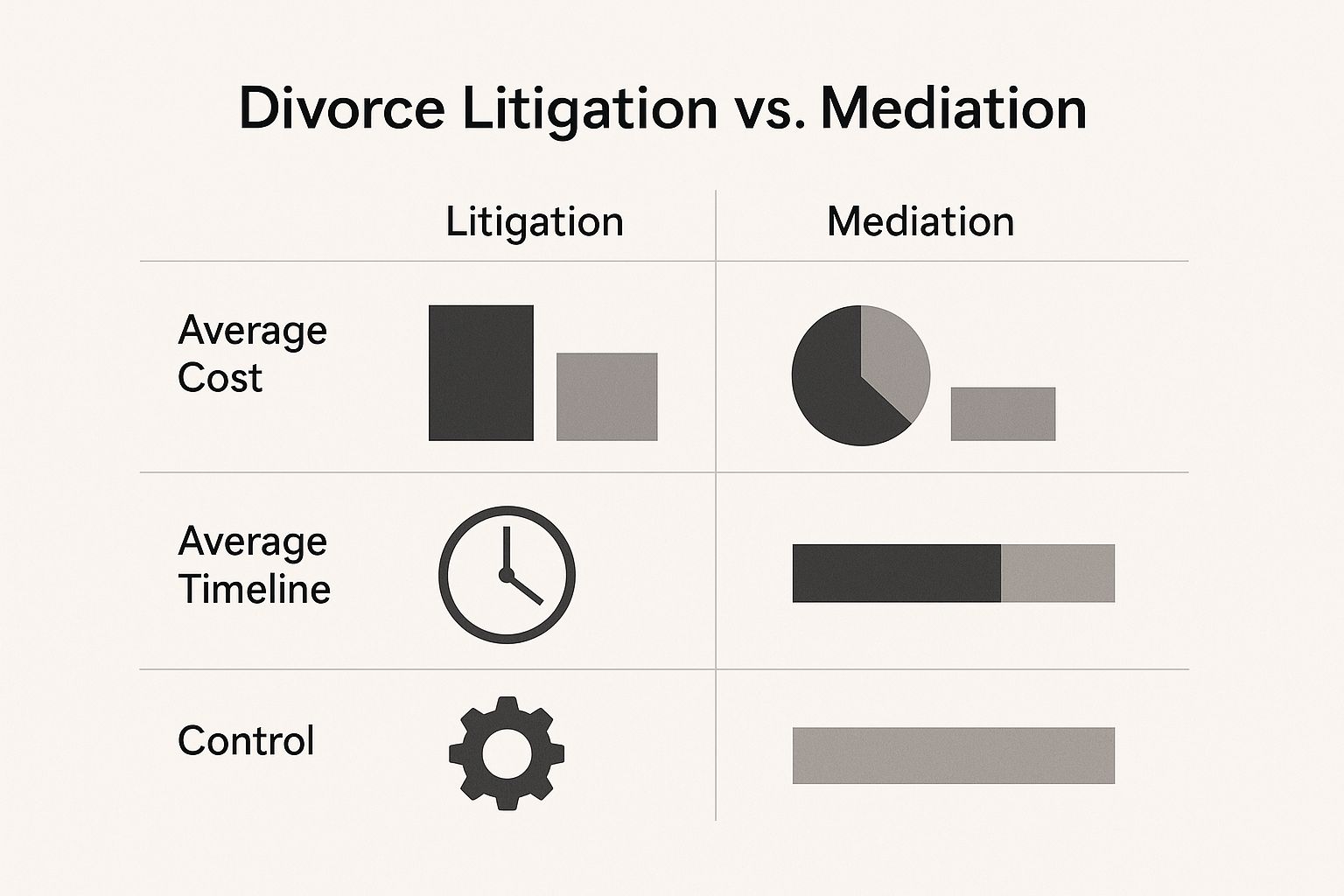
As you can see, mediation generally offers a faster, less expensive process where you keep maximum control over the final outcome.
The table below breaks down these critical factors side-by-side, giving you a clearer picture of what each process entails.
Cost, Timeline, and Control: A Side-by-Side Comparison
| Factor | Divorce Litigation | Mediation |
|---|---|---|
| Financial Cost | Can be very high and unpredictable. Attorney fees, court costs, and expert fees can accumulate rapidly, often reaching $20,000 to $50,000+ combined. | Significantly more affordable. Costs are contained to mediator fees and limited attorney consultations, often totaling $5,000 to $10,000 combined. |
| Timeline | Lengthy and dictated by the court's schedule. A contested divorce in Texas can easily last a year or longer. | Fast and flexible. Couples often reach a final agreement in just a few months, moving at their own pace. |
| Personal Control | Low. A judge, who is a stranger to your family, makes the final, legally binding decisions on all issues. | High. You and your spouse retain complete control, collaboratively crafting an agreement that is tailored to your family's specific needs. |
Comparing Texas Divorce Timelines
The timeline for a litigated divorce is largely at the mercy of the court's calendar. In Texas, there is a mandatory 60-day waiting period after filing, but a contested divorce can easily stretch for a year or even longer due to packed court dockets and rigid procedures.
Mediation, however, moves at your pace. Because it sidesteps the crowded court schedule, many couples can finalize their agreement in just a few months. This is a massive advantage for anyone looking for a quicker path to their next chapter. You can learn more about why divorce mediation could be a more cost-effective choice for Texas couples and see how these benefits play out in real-world scenarios.
How to Choose the Right Path for Your Situation
Deciding between litigation and mediation isn’t about which option is “better”—it’s about choosing the right tool for your specific situation.
Your family’s dynamics, your ability to communicate, and the complexity of your assets will all point you toward the most effective path forward. This decision will shape not just the outcome of your divorce but also the tone of your future co-parenting relationship for years to come.
Let's break down the specific scenarios where each approach is most likely to succeed.
When Mediation is the Stronger Choice
Mediation truly shines when you and your spouse are both willing to negotiate in good faith, even if you disagree on major issues. It creates a confidential, controlled environment where you can find common ground without a judge making decisions for you.
Consider mediation the superior option if:
- You Prioritize Cooperative Co-Parenting: Your main goal is to build a stable, respectful relationship for your children's sake long after the divorce is final.
- You Want to Maintain Privacy: You prefer to keep your financial and personal matters out of the public record. This is especially important for business owners and professionals.
- You Need Creative, Customized Solutions: Your family has unique needs—related to a business, schedules, or property—that a standard court order could never accommodate.
- You Are a Business Owner or Have a High-Value Estate: Mediation allows you to protect your business from the disruptions of litigation and divide complex assets thoughtfully and privately.
Mediation is fundamentally about empowerment. It keeps you and your spouse in the driver's seat, allowing you to craft an agreement that you both can live with, rather than having one imposed on you.
When Litigation Becomes Necessary
While mediation is often ideal, it simply isn't appropriate for every situation. Litigation provides a necessary framework of authority and protection when one party is unwilling or unable to negotiate fairly. The formal structure of the court is designed to enforce rules and protect the vulnerable.
Litigation is often unavoidable in cases involving:
- Domestic Violence or Abuse: The formal protections of the court, like protective orders, are absolutely essential for ensuring a party's safety.
- Hidden Assets or Financial Deception: If you suspect your spouse is hiding money or property, the court's power to compel financial disclosure through discovery is your strongest tool.
- A Significant Power Imbalance: When one spouse is emotionally or financially intimidating the other, a judge's oversight is needed to level the playing field.
- Complete Communication Breakdown: If one party flat-out refuses to communicate or participate constructively, a judge's authority is the only way to finalize the divorce.
Making this choice requires an honest, strategic assessment of where you stand. The decision you make now will define the path ahead for you and your children.
Key Takeaway: What to Do Next
Feeling overwhelmed by all the decisions on your plate is completely normal. But taking that first, informed step is how you start to regain control of your life. The choice between divorce litigation and mediation is one of the biggest you’ll make, and it will set the tone for your family's future.
One path hands the final word to a judge, while the other puts the power to build the agreement in your hands. Understanding that fundamental difference is everything.
Take Action with Confidence
Making a good decision starts with clear, professional legal advice. An experienced Texas family law attorney can cut through the noise and explain how community property laws apply to your estate or what the “best interest of the child” standard actually means for your family.
The most powerful tool you have right now is information. A strategic legal partner won't just tell you what to do; they'll lay out your options, analyze your specific situation, and help you build a plan that truly protects your future.
You don't have to walk this journey alone. The decisions you make in the coming weeks and months will have a lasting impact on your financial stability and your relationship with your children.
At The Law Office of Bryan Fagan, PLLC, we believe a confident future is built on a clear strategy. We're here to listen to your story, answer your questions, and give you the compassionate, knowledgeable guidance you deserve. You don't have to have all the answers right now—you just need to take the first step. Schedule a free, confidential consultation with our team today to discuss your case and learn how we can help you and your family move forward.
Frequently Asked Questions About Divorce and Mediation
When you're weighing divorce litigation against mediation, it's natural to have questions. Getting clear, practical answers is the first step toward making choices that will protect your family's future. Here are some of the most common questions we hear from Texas families just like yours.
Can we still use mediation if we disagree on everything?
Absolutely. In fact, mediation is specifically designed for couples who have disagreements. A skilled mediator’s job is to help you have productive conversations, find common ground you might not see on your own, and guide you toward a compromise. The only real requirement is that both you and your spouse are willing to show up and participate in good faith. Even the most heated arguments over property or custody can often be resolved with a neutral professional steering the discussion.
Is it necessary to hire my own lawyer for mediation?
Yes, it is strongly recommended that you have your own attorney, even in mediation. A mediator must remain neutral and cannot give either of you legal advice. Their goal is to help you reach an agreement, not to ensure that the agreement protects your individual rights. Your own lawyer is your advocate. They will explain your rights under Texas law, help you prepare a solid negotiating position, and review any final agreement to make sure it’s fair and protects your interests.
What happens if we cannot reach an agreement in mediation?
If you can’t resolve every issue in mediation, the effort is never wasted. Any discussions you have are confidential and cannot be used against you in court. You simply move forward with the litigation process to handle the remaining issues. Often, couples are able to settle at least some of their disputes in mediation. This narrows the focus of a court case, which can still save you a tremendous amount of time, money, and stress.
At The Law Office of Bryan Fagan, PLLC, we know you need clarity and a solid strategy to move forward. We're here to provide both. Schedule a free, confidential consultation to get answers to your specific questions and build a plan that's right for you.